|
|
School of Economics Hosts International Symposium on Sustainable Development and New Quality Productivity
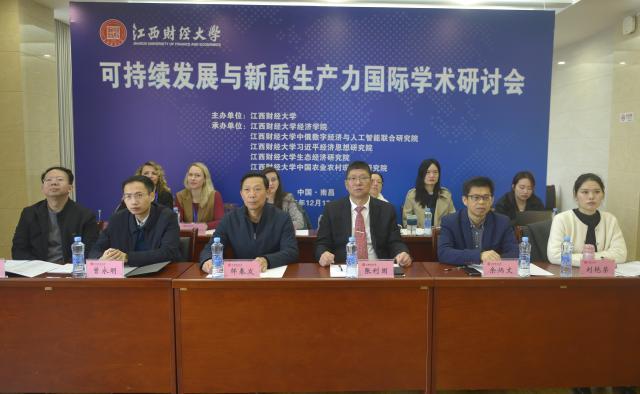
On December 12-13, the School of Economics successfully convened the International Symposium on Sustainable Development and New Quality Productivity. The conference adopted a hybrid format combining in-person and online participation, featuring separate sessions for faculty and students. Experts, scholars, and students from multiple Chinese and international institutions and research organizations attended, including Western Michigan University (USA), Memorial University of Newfoundland (Canada), St. Petersburg State University of Economics (Russia), Moscow State University (Russia), Rutgers University (USA), Guangdong University of Foreign Studies, and Jiangxi University of Finance and Economics. The symposium focused on core themes of sustainable development and new-quality productive forces, emphasizing theoretical innovations and practical pathways in related fields to foster academic exchange and mutual learning between China and the international community.

Professor Zhang Liguo, Dean of the School of Economics, delivered the opening address on behalf of the school. He emphasized the vital role of sustainable development and new-quality productive forces in global economic transformation, extended a warm welcome to all attendees, and expressed his best wishes for the conference's success.

The two-day symposium provided an opportunity for Chinese and international scholars to share cutting-edge research findings. Professor Huang Weijiao from Western Michigan University conducted an in-depth analysis of employment market trends in the digital economy context, exploring development pathways and practical value for sustainable artificial intelligence. Dr. Ding Liang from Guangdong University of Foreign Studies focused on the differentiated impacts of deindustrialization on China's urban economic growth, analyzing adaptive strategies adopted by various cities in response to these impacts; Professor Fang Tao, Stephen Jarislowsky Chair Professor at Memorial University of Newfoundland, Canada, systematically elaborated on the impact mechanisms of artificial intelligence on labor market employment structures and income levels based on empirical data from China; Professor Zhang Liguo from Jiangxi University of Finance and Economics examined the specific role of agricultural machinery socialized services in reducing fertilizer application for grain crops and promoting green agricultural development, considering smallholder farmers' land resource endowments; Dr. Anastasia Nesterova and Dr. Aleksandra Selezneva from Saint Petersburg State University of Economics, Russia, jointly shared insights on constructing real-time ESG disclosure mechanisms and how intelligent accounting and reporting systems support high-quality development in the digital economy. Dr. Wei Xiaolin from the School of Economics at Jiangxi University of Finance and Economics analyzed the deep-seated impact of urban network centrality on employment stability from the perspective of corporate equity control networks. Dr. Vladlena E. Zarembo from St. Petersburg State University of Economics focused on Russian SMEs, exploring their digital development maturity and practical pathways and challenges in the digital transformation process. Professor Peng Xinwan and graduate student Peng Yu from the School of Economics at Jiangxi University of Finance and Economics co-authored a paper analyzing the synergistic enabling effects of green finance and digital transformation on corporate ESG performance, drawing on practical experiences from China's green finance reform and innovation pilot zones. Professor Jin Yanhong from Rutgers University in the United States conducted in-depth research on industrial robot application scenarios, revealing their dual role in enhancing corporate productivity and optimizing product quality. Dr. Abel Dula Wedajo from Ethiopia shares his country's green transition practices, exploring topics such as the Renaissance Dam construction and electric vehicle industry development, and their impact on Africa's geopolitical landscape; Dr. Arthur William Fodouop Kouam from Cameroon focuses on generative AI technology, analyzing its core value in building human-machine collaborative resilience and how it can help Chinese cross-border e-commerce SMEs reconstruct their operational models and enhance supply chain agility; Dr. Muhammad Aftab Rafiq from Pakistan provided an in-depth interpretation of China's 15th Five-Year Plan (2026-2030), outlining key areas and core initiatives driving sustainable green transformation.
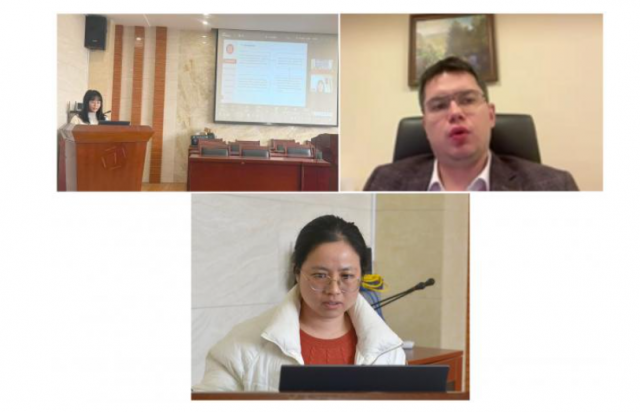
Dr. Liu Lili from the School of Economics at Jiangxi University of Finance and Economics examined the patterns and underlying logic of how artificial intelligence applications influence labor mobility across industries, based on empirical data from China. Artem Alexandrovich from Moscow State University analyzed uncertainties in global climate governance and projected the development prospects and response strategies of the Eurasian Economic Union within the global climate agenda. Subsequently, Dr. Wang Xiaoqin from the School of Economics at Jiangxi University of Finance and Economics systematically analyzed the current state of intergenerational upward income mobility in China and conducted an in-depth decomposition of its structural characteristics. This international academic symposium comprehensively showcased cutting-edge explorations and research achievements by Chinese and foreign scholars in related fields, establishing a high-quality platform for cross-national and interdisciplinary academic exchange. Following the faculty session, a student session was held. Through in-depth intellectual exchanges and mutual learning of experiences, faculty and students further expanded the depth and breadth of the school's international exchanges, providing robust support for theoretical innovation and practical application in the fields of sustainable development and new productive forces.
School websit link ://tmcmoriginal.net/news-show-6849.html
Written by Xujia Liu Translated by Yang Lu
|
|





